Sunday, September 19, 2010

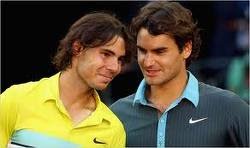
The Challenge of Being Rafa in a Roger Era

First of all let me tell you a truth. I wanted to write this article when Rafael Nadal won Wimbledon 2010 after a breathtaking tournament in which he appeared to have shaken off the tag of King of Clay and moved on to become a complete player. I was just caught up with other things and it became a little late for the article to be of immediate relevance. So I told myself “let me write this when Rafael Nadal wins the US Open later this year”. I do not know if it was just an educated guess or gut feeling that told me Nadal would win. And win he did. In what style!!


It was yet again a clinical performance from a man who could go on to become the greatest player of all time. Yes I just said that even though a certain Swiss gentleman going by the name of Roger Federer still plays tennis with the same finesse as the time he looked invincible.

The Federer-Nadal rivalry is in my opinion a celebration of two distinct yet pivotal attitudes in life- perfection versus perseverance. And I do not mean to say that each of these gentlemen portray the values respectively. What I mean is that each of them is persevering to make themselves perfect and yet keep finding that the state of perfection that they wanted is not exactly perfect and hence they try some more. They keep raising the bar.

To add a little bit of history to this duel, it could not have come at a better time. Of course, there have been all the great rivalries over the years- Borg vs McEnroe, McEnroe vs Connors, Lendl vs Cash, Becker vs Edberg, Sampras vs Agassi, Chris Evert vs Margaret Court, Navratilova vs Graf and Graf vs Seles.

Seles vs Graf ended in 1993 and even when Seles came back from the stab, she was never the same player again. That’s when Sampras vs Agassi became a rage. It was an intriguing matchup between the greatest serve and volley player of all time vs the greatest baseliner of all time; one of the best servers in the game vs one of the best returners in the game. It produced scintillating tennis for a decade from 1990-1999. I say 1999 here despite the fact that both Agassi and Sampras played on for a couple of years but they were well past their prime. 1999 Wimbledon Final was the best ever tennis we have watched Sampras play. After losing the match in straight sets on the 4th of July, Agassi said “The Man walked on water; I couldn’t do anything”. Sampras did walk on water and never again would play tennis at that level.

For the next 5 years a lot of wanna be Kings tried their best – Marcelo Rios, Carlos Moya, Marat Safin, Lleyton Hewitt and the Clay brigade- Albert Costa, Juan Carlos Ferrero and Gustavo Kuerten. They were all very good players but none of them could be termed great. Becker and Edberg had long gone, Ivanisevic went away in glory, Rafter silently disappeared and then Sampras retired in 2002 with the US Open crown defeating Agassi who became a pale shadow of the great baseliner that he was in his prime.

Men’s tennis needed fresh faces and new champions. A young pony-tailed Roger Federer had beaten the mighty Sampras at Wimbledon and won Wimbledon in 2003. He was showing glimpses of his greatness to be. Rafael Nadal was a precocious teenager looking to break into the top 5. Michael Chang had once been nicknamed “Bullet Train” for his relentless returns and the ability to run down every ball. The world was witnessing a similar phenomenon on the rise in Nadal. Nadal won his first ever meeting with Federer at Miami Masters and went on to win the French Open in 2005.

By 2007 the rivalry had become intense but it was one-dimensional: on clay Nadal was invincible, on grass Federer was playing on another plane and on the hard courts they were well matched but Nadal held the upper hand in terms of wins. Nadal looked like the only man capable of beating Federer. So dominant was High Royal Highness.

Without doubt Federer has one of the best game that we have ever seen- his athleticism is good, his serve only second to Sampras I would think, his baseline play is efficient, he is adept at the net, his forehand is devastating and poignant at the same time, his single-handed backhand is silken and finally his attitude and the desire to win unmatched. In my opinion, he is the most aesthetically pleasing all round player of all time, yes even above Sampras. I adored Sampras, he was my first childhood hero- with the typical swagger walk, his tongue sticking out while he served those bombs, those empty trouser pockets, slam dunk overhead volleys, the beautiful 45 degree head bent single handed backhand and the breathtaking running forehand- he was simply awesome. It was the greatest natural talent on display. And then arrived Roger Federer. Nobody would believe what he did on the tennis court. His game looked as though it was a robot playing perfect tennis. It was powerful yet poignant, rich and real. And for 5 years he was simply unstoppable. When you made the draw, you could almost close your eyes and put Roger in the final of the Grand Slam, he made 23 consecutive semifinals, 10 consecutive finals, overtook Pete Sampras for the record and won the elusive French Open as well. He attained unparalleled glory with that 16th Grand Slam. History books would not have even had second thoughts about the greatest ever player of all times and surfaces but one man made that difference. He has brought in the uncertainty and made an argument possible and necessary whether Roger Federer is the greatest player of all time – Rafael Nadal.

When Nadal was winning the French Open year after year and beating Federer on his way, he was still only the “King of Clay” who could have the confidence to beat Federer on any day but yet to attain glory on another surface. He worked his way to two Wimbledon finals in 2006 and 2007 but lost both to Federer and people were almost decided that grass would be his Roger’s Clay. And then came the turnaround. He beat Federer in the 2008 Wimbledon Final in what is considered by many as the greatest tennis match of all time. In pitch darkness on the third Monday of Wimbledon after two rain stoppages and almost 5 hours of impeccable tennis, Nadal conquered the demons of grass.

That was the turnaround he had wanted. He had been No.2 to Roger Federer for a record 160 weeks. No player had been No.2 for so long. He told the world that he was happy to be second to the greatest player of all time. He has always held Roger in a pedestal. But deep inside him, his heart would have cried out in pain and anguish that a man of his ability and effort has to wait so long to be at the pinnacle of his sport. Once the moment came, Nadal pounced on it. 2009 Australian Open was another example. He pummeled Federer for the crown. Destiny’s child had his day. He became No.1 but injuries brought him down. Almost eight months out of tennis, even he might have wondered if his knees would ever let play tennis again. But once again, the workhorse in him came out. He recovered and came back to win his 5th French Open. When he came to Wimbledon 2010, it was evident that he had worked hard on his game and fitness. His volleys were impressive and serve was improving as was his backhand. He sailed through the early rounds and went on to win the championship without losing a set. This was liberation from the tag of “King of Clay”. He was a force to reckon on any surface now. And then the US Open triumph. The world waited in anticipation of the first Federer- Nadal US Open Final. But Djokovic ensured it did not materialize. And I think for good measure. For I could not have borne to see Roger Federer cry again. Roger’s cry after the defeat at Australian Open 2009 signaled his dismal failure in trying to overcome Nadal. And it might have broken the great man down if he had reached the US Open Final and lost again to Nadal which was highly likely given the form Nadal was in.

Just take a look at these stats from the newspapers:

At the age of 24 Nadal is the youngest man to win a Career Grand Slam. He has won 9 Grand Slams while Federer had 6 at the same age. He has an 82% winning record while Federer had 76% at the same age. He has been part of 3 Davis Cup triumphs for Spain while Federer does not have a title. He has won the Olympic Singles Gold while Federer is yet to win in singles although he has the doubles Gold. He has a 14-6 Win Loss record against the No.1 player while Federer at the same age had a 2-3 win loss record. This is a vital stat. To be so consistently successful against a man considered the greatest player of all times is a stupendous achievement. But therein lays an irony. This will go down as the Roger Era when the smiling beloved gentleman called Roger Federer displayed such immaculate skills, finesse and art that was as pleasing as a Rembrandt painting and ruled the tennis world except for one man Rafael Nadal.

And it is no mean achievement. Nadal has worked his soul out for this. Those long hours at the gym to get those superb Rambo style biceps and the stamina was not easy. He slogged for it. And then his game was built with sweat and blood. Every shot was learned and tried and practiced a gazillion times before they became useful to him. Those legs of his have withstood strain that have been the equal of a million earthquakes. And those knees have troubled him like Achilles’ heel. Make no mistake about it. I might sound as though I am exaggerating it here but you’d know what I mean if you have watched Nadal go pounding after every ball and return them as though his life depended on it. Those nerves and muscles and tissues have been stretched to their sheer physical limits. And yet he seems capable of returning just about every ball wherever the opponent dares to hit it. You can send him flying down to both flanks alternately with such speed and yet he runs each of these balls down and returns them. It is his calling. He is called the “Golden Retriever” and how beautifully apt is it? Over the last season he has toned down his biceps, become fitter, leaner and yet stronger. He has worked tremendously on his game. His serve is so powerful that even Federer thinks it is awkward. His backhand has become stronger. His net play is more craftier, his angles are so precise, that forehand has become even more devastating and of course those legs of his are now more eager to run down every ball. He has become such a complete all round player now. This is what has enabled him to be so successful on grass and the hard courts. Just imagine this. Nadal won Wimbledon 2010 without dropping a set and the last man to do so was Bjorn Borg back in 1976. Not even the great Pete Sampras, regarded as the greatest grass court player of all times, could do it while he won 7 Wimbledon Championships. And grass was considered Nadal's potential weak link. Just goes to show how much effort goes into his game day in and day out. And then when critics said he has not got past the semis in the US Open, he came up with a thorough clinical performance to win the US Open. And now people have started arguing that he is the perhaps the greatest player of all times in terms of his sheer performance.

Nadal has never let these claims affect him. He has always been a fascinating person off the court. Who would forget his younger days’ press calls where every sentence of his would end with a “No?” He has charmed everybody with his respect for the game and the opponent. He has never sledged or been reprimanded for misbehavior on the court. He has been a graceful champion. He has transformed beautifully from the boy wonder to the gentleman champ. I think he has had such a good example in Roger Federer- probably the best-spoken champion of all times. Nadal looks up to Federer. They are such good friends and share a rapport that is very rare among such intense rivals. Even in the heydays of the Sampras-Agassi rivalry, Sampras was always the superior player and Agassi had an easy job acknowledging it. But in the Federer-Nadal rivalry, it is Nadal who is the dominant player and he is graceful in conceding that Roger is perhaps the greatest of all time. But that is the irony. Even as he works to become more successful, even as he attempts to win more slams, even as people argue whether he is truly the greatest men’s tennis player or is it Federer, Nadal knows that it will go down as the Roger Era unless he does something special to overtake Federer’s tally of Grand Slams. And it is not going to be easy. We saw the stats for Federer when he was 24 but after that he won just about everything. That will be Nadal’s challenge. To keep his fitness, stamina and desire so that he could go chasing after those big slams will require the same amount of effort that he has put in so far to get here. That will be the challenge of being Rafa in a Roger Era. But if at all any man could do that, it is the Golden Retriever.

Men’s tennis is at such a crucial happy juncture that the two best players in the world are such fabulous charismatic champions and they are still hungry for more. And for Rafa, the climb to destiny begins here. Those bullet legs of his are ready to run the race to retrieve the glory that is truly his. Whatever history may go on to say, Rafael Nadal is a people’s champion. Vamos Rafa! Go Retrieve!

Saturday, August 21, 2010

The Real Deal


Every so often, most writers are confronted with the question of what is their unifying theme or the one thread of thought that can categorize them into this school or that. In simple words, what do they write, why do they write and also who do they write about.

I have not been confronted with this puzzle until now but I decided to give it a thought. For long I have always considered myself as not belonging to any particular school of thought. For I have always been repulsed by the thought of unconditional conformity and that is precisely what any so-called school of thought bears down upon its followers, either implicitly or explicitly.

I do not claim to be widely read for there is still so much I wish I would have read by now. However, of those that I have read, I have been fascinated by a few people who also typically did not care to belong to a particular school of thought. The few examples that I can give here are Giambattista Vico, Friedrich Nietzsche, Karl Marx, Isaiah Berlin and most recently Steven Levitt. I would like to explain about each of their respective uniqueness in a different essay for it would deserve a lengthy treatment.

But I have often wondered that in wanting not to be part of any so-called school of thought, have I unwillingly let myself to be a part of a group of people who down the ages of history have also had the same concerns as me? Before I can begin to think of an explanation another question arises in my mind. Does it really matter whether I belong to a school of thought or not? If I am perceived to belong so be it. I do not conform to any unconditional obeisance anyway. So how should it affect my writing? In that case the question that is pertinent is what do I write and why do I write. That is the Real Deal.

But again it's such a big question to answer - what and why! But I think generally I can paint a broad picture of what it is that I wish to achieve by my writing. So let me give you the real deal then.

There are times in life when one is tempted to let go because the questions seem insurmountable, when the challenge appears too big, when all the wisdom obtained from living does not make sense and everything goes horribly wrong. At such times, it is difficult to retain composure and think rationally as if the stakes did not depend upon the anticipated actions, and yet that is exactly the path that will lead to the most logical and favourable outcomes.

There are other times in life when things go too well; everything seems fine; success appears to embrace your legs tightly every step of the way; when the world seems to conspire to make your wish as its command. At such times too it is difficult to keep your head on your shoulders; it is a struggle to keep your feet firmly planted on the ground and attempt normalcy. Yet the attempt to normalcy is the very effort that will prevent the dissolving into one's own pride.

Life is not always about success or difficulty either; there are times when the effort required to handle a situation is way too disproportionate to the stakes involved - either too high or too low or anywhere in between. The choice of prioritisation is called for and yet there is no magic balance that will put optimal weightage according to the gravity of the elements in consideration.

And there are these microcosmic junctures, phases and moments - like questions of school, college, education, career, job, place of work, investments, family, friends, community involvement, marriage, interactions within each of these parameters - that throw their own multitude of options and reactions before us wherein to do or not to do is not often the question but rather how to and how much to.

FAQ's was a brilliantly innovative management concept. The underlying belief that a large number of people will have the same questions on their minds is a truism. And creating this list of FAQ's with the expected answers has saved a humongous amount of valuable productive time. However the flip side is, we do not have comparable sets of FAQ's for all the times in life that I have just mentioned above and all the other times that are too fragmented to be considered under one single category head and hence have to be called "Others", although they are no less important than any other timeframe in life and sometimes even go on to determine life's directions.

So the tendency is to ask oneself - are there answers to these searching questions ? If yes, are those answers applicable to my life ? If yes, is it possible for me know them when I need them the most ? If yes how do I get those answers ? Are there clearly defined rational-logical paths to these answers that effort will lead me to or is it trial-and-error-to-each-man-his-own-ways ?

My purpose is not an attempt at providing one-size-fits-all solutions for all of life's existential problems; in fact I do not even propose to provide any solution at all. This space is just an expression of the thought processes I have waded through when I was confronted with existential issues and how they have engendered my opinions on the myriad concepts and categories that permeate and circumambulate life.

Sunday, July 25, 2010

The Last Airbender

No I am not talking about Manoj Shyamalan’s movie. I am talking about a certain gentleman who can make a cricket ball spin on glass – yes , Muthiah Muralidaran.
As he walked away from the field, having just taken his 800th wicket in Test Cricket, I wondered to myself if we had just seen the last airbender of cricket.

With 800 wickets in a 133 Test Matches, 67 five wicket hauls in an innings, 22 ten wicket match hauls, Murali has probably established the Bradman equivalent of bowling.

There are some cricketers who have an aura around them based on their supreme talent and there are others who have performed on an unbelievable plane throughout their career and yet could never attain that aura. Keen observers of the game would say Gundappa Vishwanath was a remarkable player but it was Sunny Gavaskar who cornered all the glory. Rahul Dravid is arguably India’s greatest Test batsman but is unfortunate enough to be born in the same era as a certain Sachin Tendulkar. Muthiah Muralidaran was a man whose performance and consistency may never be matched in the times to come but it is Shane Warne who has imposed himself upon the public. I am not for a moment trying to say that the Tendulkars, Gavaskars and the Shane Warnes of this world do not deserve their due. On the contrary, so do the Vishwanaths, Dravids and the Muralis.

As a cricketer, Murali is the living dream of every budding cricketer. A childlike enthusiasm, never say die attitude, an infectious smile, supreme fitness and mastery of his class, he was the perfect melting pot of cricketing virtues.

At the time that he was called for chucking, he was a novice attempting to break into the world of stardom. I still remember that series when Arjuna Ranatunga walked away from the field after a heated argument with Darrel Hair. It was to be the precipice that turned a budding youngster into an extraordinary cricketer. Muthiah Muralidaran decided to enhance his skills and prove the world wrong. Those hours at the nets under the watchful eyes of Dav Whatmore and the calm strategizing mind of Arjuna launched Murali on a trajectory of his own. It was soon clear that Murali was going to achieve many peaks.

And then he was called for chucking again and by the same umpire. It was time to change the game. Murali’s bio-mechanical tests in England opened a new chapter in the rules of the game. By that time it was clear that Murali would go on to hold the record for most wickets in both forms of the game.

What makes him stand out for me is his respect for the game. If you see him train, you’d realize that even at this stage of his career, he feels the game is bigger than everyone and he knows there’s always something more to learn. That is a trait so typical of all those who have achieved unparalleled glory in the game. He is still one of the fittest members of the team and can probably shame some of the youngsters with his athleticism. He has never indulged in sledging; never been in a brawl; never lost his head. This rigorous discipline combined with his undying passion to compete has left his fingers bruised and sore many times. But that has never deterred him from another over. Anil Kumble was known for his relentlessness. Murali for me is the greatest workhorse that has ever been. And no one has seen him complain, fake an injury or hide an injury. I might still consider Shane Warne as the greatest spinner of his generation but Murali is probably the most outstanding contributor to a team.

Another great facet is his ability to innovate. Saqlain Mushtaq was once the best proponent of the Doosra. But once Murali learned the art, he took it a step further. A handful of players can pick the doosra even now.

I remember my high school physics talked about a certain Norman effect on a ball that spins. I probably think it should now be renamed as the Murali effect. Not merely on the cricket field, his humanitarian work in the wake of the Tsunami made him a national icon in a country caught up in ethnic strife for generations. It was fitting that he bade farewell at Galle- a stadium that had been devastated by the Tsunami and a place where Murali had helped build houses for the affected. I believe it is poetic justice that a person of Tamil orgin would be SriLanka’s greatest cricketer, for every time a community is on the threat of vanishing, it produces something that will outlast time.

And the last test was also momentous and symbolic. Murali had never been able to dominate the Indians consistently. Sachin had always mastered the wizard. And yet just as a farewell, Murali’s five wickets in the first innings orchestrated an Indian collapse and he got Sachin out as well. I was happy that a great man’s finale was a fairytale script. Those glorious endings do not come easily at all. But if ever there was someone who deserved it, it was Murali.

It is generally a pleasure to recount the best moments. But with Murali, it is a pleasure to watch him bowl. He is just different and I loved that always. The ball spinning from his right hand to his left hand as he started his run up, and then as he neared the umpire, those famous elbows of his taking control of the ball and the spinning fingers imparting revolutions on the ball, the ball lands and spins 90 degrees on a flat first day pitch in England with overcast conditions, those big eyeballs pleading with the umpire and the buck-toothed grin spreading from ear to ear that you’d think it’s a school boy running around- nobody can do it again.

In times where careers do not last for more than half a decade, Murali’s records will stand. Salute to a man whose spirit was that of the game itself. Goodbye Murali, we will miss you!

Sunday, June 27, 2010

A CONFESSSION AND A COMPARISON

A confession is almost always confined to the realm of religion. However not many realize that a confession is in its basic character, an attempt at self-introspection. One tries to understand one’s own actions on the basis of the thought process that guided the actions at the time (what Max Weber called the interpretative understanding in a different context) and also the impressions that registered on the mind as to the nature, purpose and effect of the action on oneself and the others. A confession is a deep intricate analysis of time. You try to simulate a state of mind that was at the time of the actions and yet you are not reliving it either.


Also a lot many people believe a confession is a discrete activity every time it happens. I firmly believe it is a continuous process of self-introspection, contemplation and analysis that drives your perceived value-system and actions.

I present below a confession that Karl Marx made in one of his manuscripts (Source: Eric Fromm’s book:- “Marx’ concept of Man) However it is not a typical confession that people associate with the religious domain. This is what I call the “introspection analysis”, an attempt to define clearly a lot of thought processes and to crystallize firmly held notions that drive human actions. I have also attempted to compare the same metrics to my own analysis and also that of my brother, Saravanan. This was activity we did a couple of years ago. I understand that both myself and my brother have moved along in life gaining more insights and experience and hence a lot more trains of thought, I believe that these measures portrayed below exemplify a basic outlook to life and still form the framework upon which more elements have been added.


Sunday, June 20, 2010

The Survival


It was a dark and stormy night when I ventured into the forest. The question had haunted me enough and I could not wait anymore. Dr.Grace was not around when I left else she would not have agreed to it. I did not want that. She can be trusted no doubt, but the moment does not give me the luxury. She is the only one who can save it now. Moreover we had no choice now and I had no time to waste and yet I could not help looking around me.

The Apollo partially lit the northern sector of the forest. I remembered my time in the school. They had taught me Apollo was a mythical Sun God of the Greeks. I did not bother then. The Greeks are geniuses to have named the Sun after Apollo. They had predicted what was to come in the year 2154. Only trouble with earthy knowledge is that on Alpha Centauri, 44 trillion kilometers away, it turns upside down. The Sun rises at night. Having said that, Apollo is a Sun worthy of its Godly name.

There was a stiff breeze blowing across my face. I have always loved that. I walked and the breeze followed me like a pug, hither and thither but all around me. I would not have had this luxury of walking had my brother not been murdered. My brother had the nous to be the best physicist since Something Hawking but he was always clumsy with a pistol. I was the expert shot. My mind went back to that robbery. I looked skywards to pray for my brother. It was a pleasant blue and I felt a few raindrops on my face. I closed my eyes and soaked in the moment. I felt something soft on my hands and arms. I did not want to open my eyes. But the sensation was growing thicker. I opened my eyes and they were all around me, gently rising with the wind and pushing me as though they wanted me to move. I was almost in a trance by then. I moved with their flow and in a few paces was standing before the mighty Tree of Souls. I felt a force hit me and move inside my body from my head to toe. I realized I had the answer to my question. Miles Quaritch had to go. I had to go too but that was insignificant. I rushed back to the unit and to Miles’ quarters. He was snoring. I steadied myself and pulled the trigger. I took his hands and keyed into the server “Emergency, Alpha, Jake wandered and was attacked. I go SOS. Grace will lead if no return”. I went out. It was raining hard. I closed my eyes. Eywa was all around me. “Neytiri, Pandora shall survive” I thought and I jumped into lionia’s den along with Miles’ body. She had been hungry for too long.

Sunday, April 25, 2010

Sky is the limit or is it Sachin Ramesh Tendulkar?

                           
Anybody remotely connected with the game of cricket would love to answer it in favour of the young man who has just turned 37. Let us take a moment to understand what he means to a country and its people where even mediocre passes off as good.

Pages and pages have been written about him and dictionaries have been whetted to find new words to describe his art and yet he conjures something new that challenges the common man and the poet alike to explain and describe.

166 Test matches, 442 One Day matches, 31000 international runs, 93 international centuries - what keeps him going? How does he manage to perform so well for so long? How does he continue to win hearts without losing his credibility at any point of time in his career?

For us to understand this phenomenon of a man, let us try to break him into the different realms of life that he has so successfully mastered in order to be where he is today.

The Love:

The first pertinent factor that explains his longevity in the game is his sheer love for the game. He still treasures the beauty of the game. His celebration in taking Rahul Dravid’s catch (although it was ultimately ruled not out) in the semifinals of IPL 3 showed how much he still enjoys the sport. The game still excites him. He believes that there still remains unexplored beauty in a game that has been dissected by commercialization. His infectious love for the sport transports him to be a school boy who eats lives and breathes the sport. “Love what you do and do what you love” goes Blackberry’s most recent tagline. How true is it of a man who has loved the sport as his dear life for all his life.

The Hunger:

When you love something, you want to do it well and do it again and again, better and better. Sachin has done just that. He has reversed the relationship between age and performance from being directly proportional to inversely proportional. For a man who made his international debut in 1989, it is indeed remarkable that he can carry on like a machine and still capture the hearts of billions of young new cricket watchers today. And even today when he steps on to the cricket field, one can see that the same fire that lit up his eyes two decades ago still burns high and with the same intensity to outperform the others. All artists have the desire to perfect their art. The little master is no different. Once Harsha Bhogle famously said that Sachin actually said “2” to himself before playing a ball and in fact got 2 runs in that ball – that is the masterclass he brings to his game. He has no hesitation to ask even the youngest member of the team about his game. The T20 version was supposedly a young man’s game and supposedly a hitter’s game. Well Sachin proved all that wrong. The class with which he has scored his runs in this year’s IPL shows that a purist, perfect in his game can succeed under any conditions. And Sachin is still one of the quickest runners between the wickets in the Indian team. Although he doesn’t bowl as much these days, Sachin can bowl medium pace, leg spin, off spin , cutters, googlies, the whole bag.

The Commitment:

It is one thing wanting to do well and another putting in the effort. For two decades now, Tendulkar has gone through the grind of international cricket – the travel, long tours, time away from family and home, failures, slumps – and yet one can never fault him for his commitment to the team and the game.

He gives it his all. Commitment involves willingness to put leave no stone unturned in the pursuit of excellence. Who can forget the fact that as a young man, he used to shadow practice at midnight before a match when all the other players would be fast asleep. Who can forget those nets sessions where Sachin would ask the local bowlers to bowl around the wicket at his leg stump anticipating Shane Warne’s tactics in 1998 and bringing all those shots into play in a rampaging innings at Chennai. Even at this age when it would be easy for him to just sit back and relax, he is constantly seeking to refine his game, modify, find new shots, helping young cricketers.

The Humility:

Humility is always a defining trait of being Sachin. He respects the game and always treats it as above all individuals. He has carried the imagination, hopes and pressures of billions of people on his shoulders match after match, year after year for 20 long years. That kind of pressure can break a brittle mind but not Sachin’s. The adulation and the attention have ruined many a great talent but could not even touch the great man. It is not easy. Fame and fortune sit lightly on Sachin, they say. Well they are wrong. They have not sat at all. They have just been standing at arm’s length waiting for the master to order them to good deeds. Sachin soaks in these pressures and converts them into energy and motivation he can use on the field. This has also helped him to be one of the most controversy free cricketers. He has never sledged. He has never been involved in match fixing or ball tampering or wild partying. There has been not one allegation of misconduct against him. He has never said no to an interview. He has never declined an autograph. He believes in setting the right example to kids. He loves them. He becomes like them when he is on a cricket field. That is how he conquers all these pressures. For these pressures don’t mean anything to children. That is how he lords over the cricket field. By respecting the game so much and loving the game so much, he masters the game. Even today, if anybody says they are not disappointed when Sachin gets out, I’d question their judgement.

No article about Sachin can be considered complete without mentioning some of his innings as the writer’s favourites. It is very difficult to pick from 31000 international runs and 93 hundreds but again it is also so beautifully romantic and poignant to relive those great moments when nothing else seemed to matter in the world – just watching one man bat would wipe away all the miseries and worries of this world. So let me indulge myself here by listing 10 best knocks each in Test and One day matches:

One Dayers:

1. 200 not out vs South Africa, 2010: Of course, what else could it have been? The game’s first double hundred and it inevitably came from the greatest One Day cricketer of all times. Tendulkar again asserted his landlord rights over the format.

2. 175 vs Australia, 2009: The innings that breathed life into the 50 over format after the siege by T20. Sachin single handedly took India to the doorstep of an otherwise unimaginable victory chasing a target of 350.

3. 143 vs Australia, 1998: The Sharjah Desert Storm, it was called. It was an incredible knock, matched only by the importance of the situation Sachin decimated the Aussie bowling attack to single handedly take India into the finals of the tournament. Even today, dictionaries cannot whet the appetite to describe that innings. It was batting nirvana.

4. 134 vs Australia, 1998: It was the final of the tournament and India again chased a stiff target of 270. Sachin, on his birthday, took it upon his shoulders to win the tournament for the country. It was India’s most productive year in terms of trophies won and Sachin of course was the chief architect.

5. 98 vs Pakistan, 2003: A world cup match against arch rivals that would determine who would go through to the next round. India was chasing 275. Sehwag was belligerent while it lasted for 5 overs. Sachin’s calculated assault against one of the most fearsome bowling attacks of the time – Wasim, Waqar and Shoaib Akhtar, brought India victory and thrust to the finals of the tournament.

6. 117 vs Australia, 2008: The first final of the last trination tournament in the Australian summer. India chasing again. Sachin was simply too good for the likes of Lee, Johnson, Bracken and Clarke.

7. 140 not out vs Kenya, 1999, Tendulkar flew in from his father’s funeral to play a very emotional and yet important knock that helped India qualify for the Super Six of the World Cup.

8. 141 vs Australia, 1998: It was the first Mini World Cup – the precursor to today’s Champions Trophy. Sachin took the Aussie attack of Mcgrath, Kaspwowicsz, Warne and Brendon Julian to the cleaners.

9. 118 vs Pakistan, 1996: Sharjah once again was the ambience of a Tendulkar whirlwind that smashed the likes of Wasim, Waqar, Saqlain, Aquib Javed and Ata-ur-Rahman almost had his boot also hit for sixer.

10. 82 vs New Zealand, 1994: It was the innings that defined Sachin as an opening batsman in One Day Cricket. Mark Greatbatch had popularized the concept of pinch hitting in the initial overs. Sachin played an extraordinary innings of 82 off 49 balls to announce the arrival of a master.


Tests:

1. 155 vs South Africa, 2001: India was in trouble and Pollock, Ntini and Hayward and Klusener were steaming in. Sachin counterattacked and along with Sehwag brought India a respectable total.

2. 169 vs South Africa, 1997: India had lost the 1st Test badly and South Africa had put on a huge score in the second test. Sachin hit back at one of the fastest attacks in the world – Donald, Pollock, Klusener and Mcmillan. It took an amazing catch from Adam Bacher to stop a marauding Sachin.

3. 155 not out vs Australia, 1998: It was the first test of the series and Shane Warne had priced out Sachin cheaply in the first innings. Sachin charged the Aussie attack in the second innings and left Warne in almost tears with his shots over midwicket.

4. 136 vs Pakistan, 1999: An innings that would always pain him for after having batted through back pain and taken India from 62 for 5 to within 13 runs of victory, Sachin was foxed by the wily Saqlain and Indian tail messed it up to lose the game.

5. 103 not out vs England, 2008: A remarkably efficient innings. India was chasing 387 and Sehwag had given a dream start. Sachin controlled the innings on a 5th day turner to register a superb victory.

6. 241 not out vs Australia, 2004: Sydney witnessed a different innings, not the flamboyant Sachin that we usually see but a mellowed down grinding innings - a hundred after 2 years, Sachin silenced his critics who wrote him off. The innings did not have one single cover drive.

7. 194 not out vs Pakistan, Multan: The test will be more remembered for Sehwag’s triple hundred- the first by an Indian in Tests. Sachin had scored back to back hundreds after the Sydney double but this innings was more fluent and we knew he was back.

8. 193 vs England, 2002: A fluent punishing knock at Leeds that got India its first victory in England after a long time. The big 3 – Saurav, Sachin and Rahul all scored hundreds.

9. 116 vs Australia, 1999: Melbourne watched in awe as the great man pummeled the Aussie attach and was making the world’s biggest ground look small. In a series that was marred by poor umpiring against him where he was even given out LBW when he was halfway down the pitch and the ball hit his arm, Sachin had battled single handedly.

10. 114 vs Australia, 1992: Perth was one of the liveliest tracks in the world with pace and bounce. Mcdermott and Merv Hughes breathed fire but a 19 year old Sachin met fire with fire just as he had one in the previous test at Sydney where he had dismantled a hapless debutante Shane Warne.

What an experience, each of these innings was and the countless others.

The critic:

There is bound to be and there have been criticisms thrown at him at different times. He has never been a match winner, he has always failed in the most crucial matches, and he puts self before the team and all that. Well, to me they are just rubbish. Yes he should have won us 1996 World Cup semifinal against SriLanka. Well remember India was 90 for 1 when he got out for 65. India was 120 for 8 when the match was forfeited due to unruly crowd. Yes he failed in the 2003 World Cup final. But he had scored 670 runs in the tournament and was the highest run getter converting an abysmal start to a dream run. The law of averages had to catch up somehow. Sachin himself would be the first person to admit that he should have won these games for his team. It will irk him no end and will push him to somehow do it somewhere along the line – a World Cup victory would be the crowning glory to the King of One Day cricket.

Yes there have been truly great cricketers who have played the game with such passion, panache and penchant for the game and their talents and every nation during every period has thrown up these giants. Richards, Lara, Steve Waugh, Ponting, Gilchrist, Kallis, Dravid, Ganguly, Flintoff, McGrath, Warne, Wasim, Waqar, Ambrose, Walsh, Kumble, Laxman and the list can go on. All of these cricketers have been a part of the era in which Sachin has played. Sachin has just outlasted all of them.

Brian Lara would have been the sole lord of the game. Ricky Ponting would have been the best One Day player. Rahul Dravid would have been India’s greatest test batsman hands down. VVS Laxman would have been the game’s greatest purist delight. There may not have been an argument on any of the above if not for one man – Sachin Tendulkar. In an era where even good is great, Sachin is beyond compare. He, for me, has been the game’s best ambassador for over two decades.

So is he a man, a machine, a myth or just a product of the television era? How does it matter? If the fire is still burning in him to achieve some more unimaginable feats, we are all blessed to be enthralled.

Go on Sachin. Keep thrilling us. It is a sheer pleasure. Happy Birthday!!

Saturday, April 3, 2010

The Dialectics of Human Perception

“Perception alters vision”, says my brother Saravanan. And so it does…

But what exactly are the ramifications of such an alteration must be the focus of all students of human nature. That there should be such an alteration is inevitable upon the movement of civilization and living.

How does this alteration happen? What are the conditions leading up to this alteration? What are the factors that illuminate or darken the effects of such an alteration?

The order of things in this world now exists as a result of their formation. The sheer physicality of nature is supposedly predictable, in increasing intensity and width, with the growth of species. And while such physical dynamics seeks rightful claims for study, it is not my bone of contention at this moment.

It is the sum total of human perceptive vision and its implications that I seek to explain (or even explain away).

With the growth in the number of the human species, the physical nature of the world was altered in order to create the inexorable, complex, enveloping whole termed easily as “human nature”. This human nature changed and re-formed itself with increasing interaction between members as well as that between members with physical nature. I do realize that my above two sentences stop just short of a dangerous reductionism, for what I have briefed in two sentences is, indeed, “the story of civilization”, to use Will Durant’s popular conception. However, despite a temptation, the story of civilization is neither my focus nor my academic wishful ness at this juncture.

Thus the interaction influenced the core called human nature. And as the habitation area increased, this complex called “human nature”, itself influenced and determined the movement and the growth of such civilization. And then were formed the villages, towns, cities and nation-states. This would be the macrocosmic canopy into which the microcosmic individual phenomenology enters.

At the microcosmic level, the individual is born into an existing complex (nature or culture, in simple terms). The growth of the individual and his forays into the social world are determined by the existing patterns that the inherent nature, or culture, provides. And the fluctuations or conflicts arise out of differences of evaluation of the culture complex.

The individual disorientation with the normative patterns of the cultural complex produces conflicts. Differing individual perceptions also produce conflicts. Nonetheless, the differences explicate the growth of civilization and the complexity of the human mind incorporating the whole ontology and the phylogeny divergence. Such differences in fact engender the growth of the social complex which in turn influences the movement of civilization.
Every human perception is actually an interpretation of the existing social complex and an evaluation of the individual experiences with both the social as well as the physical world. (I am not trying to bring in the whole Kantian discourse, for that would need an attendant set of explanations which might digress the path of this essay. Kantian discourse by itself requires a devoted study, understanding and explanation which make it a field of focus too large for the purview of this essay).
Every evaluation and the preceding interpretation determine the individuals’ outlook on life in general and their own lives in particular. This outlook on life provides the canvas for further evaluations and interpretations of the experiences that are to come.

And so on goes the dialectic.

This, in my opinion, is the ultimate reason and explanation of all perceivable things, order of things, the movement of such an order and the orientational dynamics of these movements.

Let me summarize the dialectic then: physical elements are formed; humanity thrives on these physical elements and these interactions lead to the formation of a social complex; such a social complex comes to assume a pervasive identity by itself (with variations across space, time and distance); the identity then influences and shapes the social complex of the progeny; the progeny interpret their own personal experiences in terms of their evaluation of the imposed, inhering social whole as well the changes they wish to see in them. And such experiences pave the way for future experiences. This is the cycle of the dialectical movement of history, the most relatively absolute (the closest I can come to “absolute”) explanation of the order of things, first and final causes, origins, purposes and effects of the existence of such an order. The order keeps changing, keeps shifting, incorporating elements that are new, altered or the old remolded into the current dimensions of space, time, distance and mind.

Despite these minor aberrations or fluctuations, the underlying canopy remains stable and so do the dynamics and the process. The inevitability of the movement can never be over-emphasized.

(And in my opinion, this movement is not a single, huge circle or ellipse or a straight line, as differing schools like evolutionists, functionalists or evangelists have claimed.
It is like a solenoid --- spring-like movement, consisting of circles of change moving forward across time, distance, mind, self and society!! )